E-Fauna BC: Electronic Atlas of the Wildlife of British Columbia

Caulolatilus princeps (Jenyns, 1840)
Ocean Whitefish
Family: Malacanthidae
Once images have been obtained, photographs of this taxon will be displayed in this window.Click on the image to enter our photo gallery.
No E-Fauna image is available for this taxon.
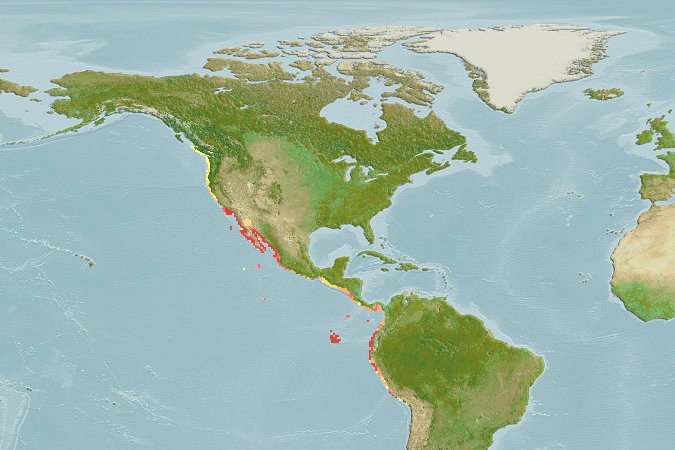
Source: Distribution of Caulolatilus princeps as compiled by Aquamaps
E-Fauna's interactive maps for fish are not yet available.

Species Information

Dorsal spines (total): 9; Dorsal soft rays (total): 24 - 25; Anal spines: 2; Anal soft rays: 23

Source: FishBase. Dooley, J.K. 1978 . (Ref. 8991).
Biology

Species Biology

Inhabits rocky bottoms (Ref. 9119). Also found on soft sand and mud bottoms. Solitary species. Digs into the substrate for food (Ref. 5227). reef-associated; marine; depth range 10 - 91 m (Ref. 5227), usually 24 - 55 m (Ref. 5227). Subtropical.

Source: FishBase. Dooley, J.K. 1978 . (Ref. 8991).

Distribution

Distribution

Eastern Pacific: Vancouver Island in British Columbia, Canada to Peru, including the Galapagos Islands; rare north of central California, USA.

Source: FishBase. Dooley, J.K. 1978 . (Ref. 8991).

Status Information

Origin StatusProvincial StatusBC List
(Red Blue List)
COSEWIC
NativeSNRNo StatusNot Listed
BC Ministry of Environment: BC Species and Ecosystems Explorer--the authoritative source for conservation information in British Columbia.

Additional Range and Status Information Links

Additional Photo Sources

General References


Recommended citation: Author, Date. Page title. In Klinkenberg, Brian. (Editor) 2021. E-Fauna BC: Electronic Atlas of the Fauna of British Columbia [efauna.bc.ca]. Lab for Advanced Spatial Analysis, Department of Geography, University of British Columbia, Vancouver. [Accessed: 2026-06-10 8:25:18 AM]
Disclaimer: The information contained in an E-Fauna BC atlas pages is derived from expert sources as cited (with permission) in each section. This information is scientifically based.  E-Fauna BC also acts as a portal to other sites via deep links.  As always, users should refer to the original sources for complete information.  E-Fauna BC is not responsible for the accuracy or completeness of the original information.


© E-Fauna BC 2021: An initiative of the Spatial Data Lab, Department of Geography, UBC