Painted Ladies have a white subapical dorsal forewing spot, unlike the West Coast Lady, in which the spot is orange brown. The subapical spot is the large pale spot second back from the wing apex, along the front margin of the forewing. Males and females are very similar in appearance.
Immature Stages
Eggs are light green and barrel-shaped with vertical ribs. First instar larvae are dark brown, flecked with lighter brown and grey, and with an irregular white line along each side of a dark dorsal line, and an irregular grey lateral line. Mature larvae are greyish brown, variegated with yellow and black. The second to fifth segments, and the last segment, are black with many whitish dots, from which fine white hairs arise. There is a line of dashes down the black, which is white on the thorax and yellow on the abdomen. The body is covered in spines, varying in colour from yellowish to brownish white and tipped with black. There is a pale yellowish dashed line down each side. The spiracles are black, with a dull yellow ring around each one. Individual larvae are highly variable in colour. The pupa is a beautiful dusky copper colour, with a metallic shine when turned under a light (Saunders 1869d; CSG).
Subspecies
None. The type locality of the species is Sweden.
Genus Description
The name Vanessa is probably from Swift's poem of Cadenus and Vanessa (Reed 1870; Emmet 1991). The common name "ladies" is derived from that of the most common species in the genus, the Painted Lady.
Ladies in BC are predominantly medium-sized to large orange brown butterflies with black markings, except for the Red Admiral, which is black with red and white markings. Adults are strong, fast erratic flyers that are most easily approached when they are nectaring. Thistles, alfalfa, and asters are favourite nectar sources (CSG), probably because ladies are most abundant in mid to late summer, when these are the predominant nectar sources.
All four of the ladies in BC are migratory and without permanent populations in BC. There are nine species worldwide.
Biology
Painted Ladies are strongly migratory, with permanent populations breeding year-round in the deserts of the southern USA and northern Mexico. In spring they migrate north, with the migrants estimated as several billion individuals in some years. Only a tiny proportion of the migrants reach BC, hence none are seen in some years and thousands are seen in other years. Apparently only one generation of offspring is produced in BC, with the first adults emerging in July. They do not appear to hibernate as adults or larvae, so BC must be recolonized by migrants each summer. Hardy (1953, 19S9b) summarizes some of the "migration years" of that time on Vancouver Island and other areas of BC. Painted Ladies appear to hibernate successfully in Colorado (Scott 1992), and one early March record in BC indicates successful hibernation. There is currently no evidence that Painted Ladies migrate south from BC in the fall. There are sporadic reports of southward migrations elsewhere, such as in northern California (Shapiro 1980b). Populations in France and North America are genetically very similar (Shapiro and Geiger 1989), suggesting that some migration across the Atlantic may occur.
Larval foodplants recorded outside BC are in many different plant families, but members of the Asteraceae, especially thistles, are the most frequently used. In BC bull thistle and Canada thistle are the most commonly used larval foodplants, and Gnaphalium, Arctium lappa, and Eriophyllum lanatum are also used (Harvey 1908; Jones 1933,1938; Hardy 1959b; ACJ; AGG; CSG). Outside BC other larval foodplants include Alcea rosea, Amsinckia douglasiana, Anaphalis margaritacea, Arctium lappa, Borago officinalis, Carduus nutans, Centaurea solstitialis, Cirsium arvense, C. callilepis var. oregonense, C. canescens, C. hydrophilum, C. ochrocentrum, C. parryi, C. scopulorum, C. undulatum, C. vulgare, Cnicus benedictus, Helianthus, Lupinus argenteus, Malva neglecta, Onopordum acanthium, Senecio bicolor var. cineraria, Silybum marianum, and many other plants (Scudder 1889a; Keji 1951; Shapiro 1975b; Byers et al. 1984; Scott 1992). When the preferred larval foodplants have been defoliated by a large population of larvae, the larvae will also feed on many other plants, including Brassica crops (Byers et al. 1984). Larvae feed within characteristic silk webs among the leaves of the foodplants. Once familiar with their appearance, the observer can identify the webs with certainty even after the larvae have left.
Habitat
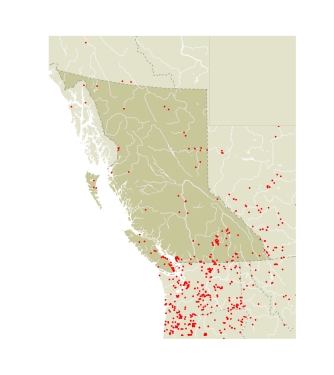
Painted Ladies occur across southern BC in open areas at all elevations, and less commonly in central and northern BC. They are one of the few butterflies seen on the Queen Charlotte Islands, and were first sighted there in 1952 (Hardy 1953).
Distribution
Distribution
Painted Ladies are probably the most widely distributed butterfly in the world, occurring throughout most of the northern hemisphere and parts of the southern hemisphere. In the western hemisphere they are permanent residents from the extreme southern USA south to Venezuela. From these subtropical and tropical areas they migrate north each year as far as the arctic.
Recommended citation: Author, Date. Page title. In Klinkenberg, Brian. (Editor) 2021. E-Fauna BC:
Electronic Atlas of the Fauna of British Columbia [efauna.bc.ca]. Lab
for Advanced Spatial Analysis, Department of Geography, University of British
Columbia, Vancouver. [Accessed:
2026-08-10 4:35:44 PM]
Disclaimer:
The information contained in an
E-Fauna BC atlas pages is derived from expert sources as cited (with permission) in each section.
This information is scientifically based. E-Fauna BC also acts as a
portal to other sites via deep links. As always, users should refer to
the original sources for complete information. E-Fauna BC is not
responsible for the accuracy or completeness of the original information.